Local Football Star Focused on Legacy Over Limelight

Jefferson, Georgia. isn’t necessarily known across the country as a hotbed for high school football talent. Malaki Starks is an exception. While he’s committed to play college football at the University of Georgia for Kirby Smart and the Bulldogs, Starks says he is first committed to his Jefferson High School Dragons and leaving a legacy on the program in Northeast Georgia. Continue reading and watching
Writer’s Note: This story was written in October of 2021 and published on Grady Newsource in November of 2021 for the journalism capstone class, Journalism Projects. The assignment required us to create a video package as the primary method of storytelling.
Robinson Reacts to Augusta National News, Reflects on His Impact in Golf
Fred Ridley, Chairman of Augusta National Golf Club, announced in a press conference last week that the club plans to honor Lee Elder, the first Black man to compete in the Masters Tournament, in a variety of ways over the next year. According to the head golf coach at a historically black college and university, Augusta National’s actions have a chance to spur on other opportunities for growth in the black golf community.
“I think there’s a huge opportunity here to expand the development and growth of minorities in the game of golf, and what better organization to step out there, step out in front and show that they’re in support of supporting that growth than The Masters,” said Dwayne Robinson, head golf coach at Alabama A&M University.
First, Augusta National will establish a pair of scholarships to be known as the Lee Elder Scholarships at Paine College, a historically black college and university located less than 5 miles away from the course in Augusta, Georgia. The scholarships will be awarded annually, one each to a student-athlete who competes on the men’s and women’s golf teams. In order to do so, Augusta National will also fund the creation of a women’s golf program at Paine College. Finally, Ridley said that Elder has accepted an invitation to join Gary Player and Jack Nicklaus as an honorary starter for the 85th Masters Tournament in April 2021.
“They’re kind of killing two birds with one stone trying to grow the game with not only African Americans, but particularly African American women,” Robinson added. “I think it’s an amazing opportunity for some of our kids, and I’m excited to see the impact that it can have long term.”
Robinson has been a part of the black golf community for quite some time and has been a teacher of valuable life lessons, both on and off the course, to hundreds of black golfers along the way. In the 1990’s, he served as the head golf coach for Chicago High School for Agricultural Sciences where he coached the first majority African American golf team to win the city championship in Chicago. Five out of Robinson’s six members of the team were African American. He transitioned from there to Alcorn State University, another historically black university, before ultimately ending up at Alabama A&M about a year ago. Through it all, Robinson feels like he’s been able to share important lessons with young black golfers across the country.
“I got involved in golf in my late 20s, and I had no idea at the time the impact that it was not only going to have on me and my personal relationships, but that it was also going to put me in a situation where I was able to use a sport that develops not only the athletic side of a young man, but also a professional development side, public relations and communication skills. With golf being the game that it is, those areas were really areas that I could focus on with a young man that may not have ordinarily gotten that playing basketball or football.”
Robinson, who once coached both basketball and golf, reflected that while sportsmanship was an important value in both sports, “golf presents a different set of experiences when you interact with a different demographic,” and that there were lessons that could be learned just by playing the sport.
“That doesn’t mean that the young men that I was coaching in another sport were any less, but a different sport takes into account a different skill set,” Robinson continued. “Of course you always have to do the same things with sportsmanship, but with golf, you’re talking about a gentleman’s game. There’s a certain way you engage with it. So helping them develop in those areas from a golf perspective was huge for me, because I knew that it was a sport that they weren’t introduced to on a regular basis and the things that come along with it.”
Among the many endeavors of Robinson’s career was a stint working with the PGA TOUR’s First Tee Foundation following his time at Alcorn State. First Tee is a nonprofit organization that introduces the game of golf and the life skills that come along with it to kids and teens. On an annual basis, First Tee reaches more than 3.6 million youth through local chapter programs, in schools and at youth centers across the country.
“I’ve had a good bit of fortune and opportunity to engage with some African American success, not necessarily in the infancy stage but in situations where it wasn’t the norm. Having those experiences motivated me to want to continue coaching,” Robinson said. “The First Tee kind of built itself on some of the things that golf can entail, and when you look at those leadership characteristics, even though they may go into other sports, golf has a tendency to expound on those things of character and leadership. I have been really fortunate to be able to engage with those characteristics of the game and impart them on the young African American men I come in contact with.”
Augusta National is not the first notable group to help a historically black college and university fund a golf program. Others, such as NBA All-Star Steph Curry, who in 2019 donated money to allow Howard University to launch Division I men’s and women’s teams golf teams, for the 2020-21 school year, have also made efforts to help the black golf community. If Robinson’s wishes come true, efforts like these will continue in the years to come.
“I’m excited about it. I’m excited about seeing the initiation of it,” Robinson said of the news to come out of Augusta National last week. “I hope that it takes place and gets roots and grows and it inspires other programs to continue to grow and be better and maybe even initiates some new programs.”
According to information collected by GolfWeek in 2019, “only about 300 of the NCAA’s more than 10,000 college golfers are black” and “just three African American golfers are on the PGA TOUR.” Only about a quarter of more than 100 historically black colleges and universities field golf teams.
Writer’s Note: This story was written in November of 2020 for Journalism Ethics and Diversity. The assignment required us to find and report on a story having to do with diversity.
Graphics Project: Poster Design

Creator’s Note: This project was completed in October of 2020 for Graphics. The assignment required us to design a poster using only one word using the tools in the Adobe Creative Cloud, primarily Photoshop. The photo used for this project was taken by myself at the 2019 SEC Championship Game.
Where are the women in sports media?
Women in sports media were once a rare breed, but over the course of several decades, it has become increasingly common to see females being the ones to ask the tough postgame questions. Vicki Michaelis, the John Huland Carmical Chair of Sports Journalism & Society in the Grady College at the University of Georgia, and Emily Proud, weekend sports anchor and reporter for WKRN News 2 in Nashville, Tennessee, are certainly examples of that. Despite the two women having their careers separated by more than two decades, their experiences in sports media are similar, and they share the same desire for females to prosper in the industry.
“We were not the first generation of women to come into sports media. We were kind of the third generation really, and those trailblazers before us had knocked down some barriers,” Michaelis said, citing Helene Elliott and Lesley Visser as two of those who blazed the trail for her and other female members of the media. “So while I realized there weren’t many of us, there were more of us coming in, so we didn’t feel completely alone.”
“We’re back in a space where it’s like, ‘Where are all the women?’” Michaelis continued, fast forwarding 31 years from her start in the industry in 1991 to present day. “For me, it was a primary motivating factor why I came here. I, of course, want to teach every student who comes through the door how to work with sports media, but I also know how impactful it can be for the women to come through the door and see me and say, ‘Hey, there’s a woman who did this.’ Just that alone helps affect things.”
The shocking differences in the two quotes raises the question, what happened in the time between?
Michaelis began her reporting career in what she considers to be a bit of a “golden age” for females entering the field, but over the course of her two decades in the industry, she saw the amount of women fade for a number of reasons. According to her, the combination of the rise in popularity of the internet changing the way media outlets handled their business, the 2008 financial crisis and several of her female colleagues reaching child-bearing age resulted in many women leaving the industry.
“We hate to talk about this because we hate that that stereotype gets laid on us like, ‘Oh, you’re going to have kids, and then you’re going to leave,’” Michaelis said. “Well guess what, it’s hard to have kids and be in sports media because you have to work weekends and holidays. I’m really lucky that I have a husband, a partner who totally picked up the slack for me and allowed me to keep doing what I wanted to do, but I know a lot of women who had to make that choice.”
As for Proud, a Belmont University graduate who got her first job in sports media in 2016, she considers herself to be a part of a recent wave of women who continue to earn their spot in newsrooms.
“I think the way that I’ve seen it evolve from somebody who watched it with wide eyes as a kid to going into it now is, in the beginning, there was a competitive edge to it between women. Not necessarily a nasty sort of thing, but it felt like you had to really fight for your spot, and there weren’t a lot of spots,” Proud said. “What I think has changed so much is that there is so much room for everyone. We have two females in our sports staff out of three on-air personalities. A few years back, that was unheard of. I was the second female in there, and I honestly told everybody, ‘I’m not getting this job. They already have a female in the sports department. They’re not going to hire another one.’ They just decided, ‘You know what, we’re going to hire the best person for the job,’ and it didn’t matter.”
“I just think by having more of these conversations and communicating the fact that it’s not unique anymore,” Proud continued when asked how she hopes her actions impact future females wanting to get into sports reporting. “This is honestly like the third interview that I’ve done in the last two months where the premise has been on being a female in sports. I think the way that you move past having that be such a unique thing is by talking about it and normalizing it. I hope to be that person that you don’t think of her as, ‘Oh, there’s Emily Proud. She’s a female in the sports industry.’ No. She’s just in the sports industry. She’s a journalist. So I think by talking about it and making it to where we just shove it in everybody’s faces, they’re like, ‘Okay, okay. We get it. Female in sports. Not a thing anymore. You’re just in sports.’”
Despite their success in the industry, both Michaelis, who created the Grady Sports Bureau upon her arrival at the University of Georgia and is the director of the Grady Sports Media Certificate, and Proud still see plenty of room for women in sports media to grow. According to the 2018 Associated Press Sports Editors Racial and Gender Report Card, only 17.9% of the total staff for the Associated Press sports sections are women, and just 10% of sports editors across the country are female. While that number has increased with almost every edition of the report card, which dates back to 2006 when women made up just 10.7% of the total staff for Associated Press sports sections, it is still nowhere near where either one of the women would hope for it to be.
“If you would have asked me in the ‘90s, ‘What is (the sports media industry) going to look like in 2020?’ I would have been like, ‘It’ll be pretty equitable by then based on what I’m seeing,’” Michaelis said. “Not only were we there, but there was a real awareness among the people who ran sports media outlets that we need to make sure that we do have gender diversity.”
“There are times when I look at the women that we have, our graduates who are out there and what they are doing, and just go, ‘Alright, it’s baby steps, but we’re making a difference. This program is making a difference,’” she continued. “That’s going to be what it takes really. It’s just, you’ve got to plant the seeds. It can’t be all done in one day … To now be seen as a trailblazer, I’m not going to lie, it’s very fulfilling. To have people tell you, and they have, which is just beyond fulfilling, when they say, ‘I decided to apply for this program because I saw you.’ And to know that this woman may not have done that had a man been in charge, means I have opened a sliding door for somebody that may not have opened for her otherwise, just by being here.”
Writer’s Note: This story was written in October of 2020 for Journalism Ethics and Diversity. The assignment required us to find and report on a story having to do with diversity.
Graphics Project: Logo Design

For my logo design project, I have sort of chosen a combination of Options A and B and will work on rebranding an existing organization with a new logo to go along with a new proposed team name. Over the summer, Dan Snyder and the Washington NFL football team made headlines when the organization announced that they would change the name of the team. The organization was first known as the Boston Braves in 1932 and later the Boston Redskins from 1933 to 1936. Then, upon moving to the Washington D.C. area in 1937, the team kept the name and changed to the Washington Redskins. Since then, they have played over 1,200 games, are one of only five NFL teams to record over 600 total wins and have won five championships, including three Super Bowls.
The team’s name and logo has drawn criticism for quite some time as it is offensive to Native Americans. A push for the name to be changed began in the 1990s, and it factored into their move out of D.C. and into new headquarters in Ashburn, Virginia with their stadium located in Landover, Maryland. It has also been a hurdle that has yet to be overcome in the fight for a new stadium. While the organization is far from the only professional sports team likely in need of a change to their name due to the association with Native American, the terms “redskin” is dated and considered derogatory slang. It was not until 2020 in the wake of the killing of George Floyd that the organization announced that they would change the name and logo. For the 2020 season, the team is playing under the name of the Washington Football Team and will continue to do so until a permanent replacement is chosen at a later date. It is my proposal that the Washington Football Team be named the Washington Warriors, because doing so would keep the concept of battling on the football field that their previous name achieved without doing so in a derogatory manner.
The objective of the brand logo is to create a team and fanbase identity that all can celebrate and wear proudly, which I believe my logo does as it offers a more welcoming option than their prior logo. It speaks to an audience of football fans for the team and those that love Washington sports alike, but it also speaks to sports fans in general as it will be recognizable by all. Competitors to the brand include other NFL franchises as well as professional sports teams in the area including the Washington Capitals of the NHL, Washington Nationals of the MLB and the Washington Wizards of the NBA as well as D.C. United (MLS), Washington Spirit (NWSL) and the Washington Mystics (WNBA) among others.
Creator’s Note: This project was completed in September of 2020 for Graphics. The assignment required us to either design or redesign the current logo for an organization and explain our thinking in doing so.
Class of 2021 Enters College Admissions Process with Uncertainty
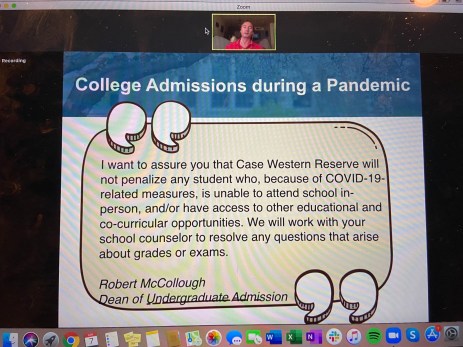
Among the growing list of things impacted by the COVID-19 outbreak in the United States is college admissions, specifically for the class of 2021 high school graduates. On Tuesday, Flip Laffoon, a tutor for Compass Education Group, said that he sees colleges being a little more lenient for those students as a result of the pandemic.
“Something that would be worth knowing for any of you who are in the class of 2021 or who work with or are parents of kids in the class of 2021 is that for that particular class, there will be much less restrictive admissions guidelines,” Laffoon told viewers in his hour long Zoom webinar.
Laffoon stated that this situation is sort of a “deus ex machina”, or a seemingly hopeless event, and that schools understand that there is really nothing that students can do at this point to move forward in their admissions process.
The availability of standardized testing is one of the differences the class of 2021 will face in their admissions process. Both ACT and the College Board, who administers the SAT, have been forced to cancel their March, April and May test dates due to the pandemic.
Laffoon is hopeful that students will be able to resume test taking in June or July and expects both groups to create as many opportunities for students to take the test as possible.
Several colleges and universities have already decided to go test optional for the class of 2021 in response to the changes in access to testing. Around 1,300 schools require an ACT or SAT during the application process under normal circumstances, but it’s likely that no schools will require a standardized test from class of 2021 applicants, he said.
One online viewer asked if their child has already taken the ACT or SAT and has a score that falls in the middle of accepted scores for a school, would Laffoon suggest submitting it. His answer reassured students.
“Absolutely yes. Like I said, I think it’s good to be able to submit a score,” Laffoon said. “I also wouldn’t be surprised if the ranges are relaxed a little bit for the class of 2021 because schools know that there are going to be very limited opportunities to retake for many students.”
While the class of 2021 is still months away from sending in applications, the status of the country come late summer and fall will play a large role in their process. As for now, the class of 2021 will just have to be patient.
“Wait and see where we are in the fall,” Laffoon said. “If things have sort of returned to normal, then I think it will just be a normal cycle with the caveat that most every school will be test optional.”
Click here to view coverage of the event on Twitter.
Writer’s Note: This story was written in April of 2020 for Reporting and Writing Across Platforms. The assignment required us to cover an event, however, due to the coronavirus outbreak, students were forced to do so online.
UGA Miracle Leader Shares about Planning for Dance Marathon 2020

Caitlin Oh, a senior public relations and psychology double major at the University of Georgia, has been involved with UGA Miracle since the early in her time at Georgia and has continued to progress up the ranks of the organization’s leadership team.
She found out about Miracle, an organization that benefits Children’s Healthcare of Atlanta through the Children’s Miracle Network, at orientation her freshman year. Now in her final year, Oh is the internal director for Miracle, meaning that she helps plan and organize the group’s biggest event, Dance Marathon. The 25-hour fundraiser organized by students to benefit the philanthropy includes entertainment for all ages such as live music and games.
What is your responsibility as the internal director?
It’s a lot of hands-on planning with events and making sure that they fill all the slots for the timeline. And so a lot of thinking about how we can make our internal experience best for our members and how we can make participants’ experience or external members who come to Dance Marathon good. Also I do a lot of relations with Tate (Student Center) contacts, and I do all the contracts for the organization and keep track of all of that.
What would you say the biggest challenge has been in organizing Dance Marathon?
I think just making sure that everything for the executive board falls into place because a lot of Dance Marathon is delegation … So I would just say like making sure that everything is in place and really like leaning on all of them and trusting them in order to make sure Dance Marathon happens.
What do you think it is about Dance Marathon that draws the regular student in to sign up and participate?
I think that Dance Marathon is really unique in the fact that it’s 24 to 25 hours. It’s 25 hours this year for our 25th year. And I think that there’s a lot of entertainment stuff that we do throughout it. So even if you don’t specifically align with Miracle or you’re not a part of Miracle, there’s something for everyone.
Writer’s Note: This story was written in February of 2029 for an assignment for Reporting and Writing Across Platforms class. The assignment required us to schedule an in-person interview with a source and produce a Q&A type story.
 Palmer Thombs