Name, Image and Likeness in College Athletics: Where We’ve Been, Where We Are and Where We’re Going
Imagine being an 18-year-old college freshman starting your first-ever nationally televised football game but not being able to have your mom in the stands after she has attended every game you have played in since you began playing the sport. Former University of Tennessee offensive lineman Jashon Robertson was faced with that situation when he and the Volunteers traveled to take on the fourth-ranked Oklahoma Sooners in 2014. Robertson’s mother Monica ended up in the stands on that September night in Norman but only after her son helped pay for the cost of a plane ticket.
Now, imagine being that son playing for a football program that generates nearly $100 million in revenue each year but not making a dime. The National College Athletic Association, better known as the NCAA, has been around since 1906 and helps oversee the more than 480,000 collegiate student-athletes who compete on an annual basis in college sports. In doing so, they bring in over $1 billion per year. For 114 years, the millions and millions of collegiate athletes who put the product on the playing surface have not been able to profit, but all that might come to an end in just a matter of months due to proposed rule changes in college athletics that would allow student-athletes to benefit from their name, image and likeness.
“That’s been a really sensitive subject in intercollegiate athletics really forever, just the whole idea of players making money more than what their scholarships were to offer,” ESPN College Football analyst Kirk Herbstreit said. “When I played in the ‘90s, that was just the way it was, and you just kind of accepted that. I think what’s happened is the amount of money that has been thrown into the pot, as the decades have passed, has obviously changed.”
Herbstreit noted the rise in coaches’ salaries as one of the major causes for the changed financial landscape in both college football and college athletics as a whole. With that came a perception that coaches no longer cared about their players and that they were simply doing their jobs for the paycheck. As that began to happen, Herbstreit said the outside influences of parents, agents and financial advisors began to stress to players the need to care about themselves and get the money they “deserved.”
At the same time, the popularity of individual athletes began to grow. Social media followings became larger, and the student-athletes developed a louder voice. Seeing their jerseys sold in the university bookstores across the country became more and more frustrating by the day without any change in their pockets. Suddenly, there was a conversation to be had.
“When I was in college, I was there from 2010 to 2013, it was earlier on in the discussion,” said Kelly McFarlane, a former University of North Carolina women’s soccer player. “There was a lot of discussion at the time around the idea of if athletes should be paid to play, but I think that conversation really centered around football and basketball, because those are the only two sports that actually make money for the university at most schools.”
“I remember thinking about it while being at UNC when Harrison Barnes’ basketball jersey is being sold in student stores, and he doesn’t see any of that money either while he’s in school or even after he graduated,” she continued. “For a long time, I think it mostly just applied to men’s basketball and football players. What has changed recently though with social media and how much Instagram has blown up and things like that is that now there are other sports gaining visibility … It changes with the prevalence of social media and the idea of followers and being a social media influencer.”
The conversation continued for several years with seemingly countless star athletes missing out on opportunities to cash in during college. Then, in September of 2019, California governor Gavin Newsom signed the Fair Pay To Play Act making The Golden State the first to pass legislation that would allow collegiate student-athletes to receive compensation for use of their name, image and likeness. California’s bill was set to start 2023, but in June of 2020, the NCAA had its hand forced with Florida governor Ron DeSantis signing a similar name, image and likeness bill that would go into effect July 1, 2021.
As McFarlane stated, with the growth of social media, there are bound to be opportunities for athletes outside of football and men’s basketball within the guidelines of name, image and likeness. At the University of Nebraska, a study conducted for FiveThirtyEight by Opendorse CEO and co-founder Blake Lawrence estimated that the sport at the school with the most average earning potential from social media was actually the Cornhuskers’ women’s volleyball team rather than the historic football program. Similarly, at the University of Georgia, the most followed athlete does not compete for the football or men’s basketball teams, instead he participates in track and field.

With the potential rule changes come several questions still needing to be answered. How exactly is this going to be implemented? Who is going to police it? What do the student-athletes really stand to make from their name, image and likeness? Those are just a few of the many different areas of concern. Most importantly though, all parties involved want to make certain that any changes do not negatively affect the product on the field.
“I do not think anybody is going to show up in the new NIL era and say, ‘Here I am, give me my money for my post,’ any more than they show up on campus, throw a couple of weights around, make a couple of 3-pointers and say, ‘Okay, pros. Call me.’ That doesn’t happen,” said Tim Stephens, author and senior enterprise account executive at INFLCR, a company founded to help athletes tell stories on social media with the idea of name, image and likeness in mind.
“You’ve got to put in the work. The same is true for the student-athlete in terms of brand building,” Stephens continued. “Few athletes will arrive on a college campus with a ready-to-monetize personal brand. There will be some for a myriad of reasons. Maybe they are an extremely high-profile basketball recruit who had hundreds of thousands of followers. There’s a handful of those. Or maybe they were someone who was just really good and interesting on social media. The vast majority will not arrive on campus with a ready-to-monetize brand, and they’ll have to put in the work to have the opportunities like they do in other facets of their student-athlete experience.”
As the clock continues to count down to Florida’s name, image and likeness bill going into effect, the NCAA remains focused on its efforts to change with the times while still regulating college athletics on a national level. According to a timeline found on the “Taking Action” section of the official NCAA website, the NCAA Board of Governors outlined specific categories in which student-athletes could earn compensation for their name, image and likeness at its April 28, 2020 meeting. Each division was scheduled to have final legislation drafted to update name, image and likeness rules by November 1, 2020, all in advance of a January 31, 2021 target date to have legislation approved by. Effective dates for the proposed rule changed would start no later than the 2021-22 academic year.
So, how are colleges and universities across the country preparing for the changes? Well, over 100 athletic departments and 800 teams have partnered with Stephens and INFLCR. Similarly, the previously mentioned Opendorse has the Clemson University football program on board with head coach Dabo Swinney referring to the company as “the Nike of that world” when asked about how the Tigers are preparing for changes to name, image and likeness rules.
As for the players, the opportunities will be there. While it’s easier to see where the big-name athletes could benefit, the less recognizable ones still have plenty to gain. Stephanie Rempe, Executive Deputy Director of Athletics and Chief Operating Officer at Louisiana State University, gave examples of players running camps and clinic or partnering with a local grocery store in their hometown as just two examples that came to mind during a recent Sportico name, image and likeness discussion. From the perspective of a former player, Jashon Robertson thinks back to fan days that he experienced while at Tennessee.
“The line would be wrapped around, people would be out there camping to get autographs of their favorite player, different units on the team, all of that stuff. You have opportunities where you’re literally giving a fan base an opportunity to come in, get things signed, and take pictures. All of that would have been a huge opportunity to gain,” Robertson said. “I’m just thinking of being in Knoxville, and all the different things I could have done, all the different times I signed autographs. I could have gotten something from it. I’m not saying charge 30 bucks for an autograph, but you could sign 150 of those in a day, and if you charge a couple bucks for it, that’s just 300 bucks in a day. That’s solid money for a 19-year-old in college.”
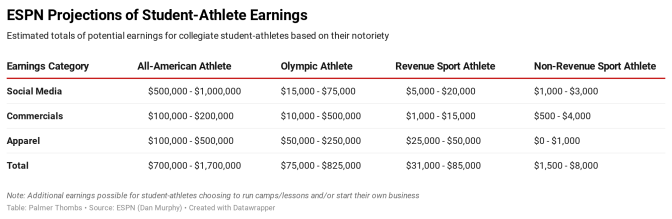
While the playing days for Robertson, McFarlane and many others are over, and their opportunities to earn while in college are long gone, the door is still open for future NCAA athletes to benefit from their name, image and likeness while playing college athletics. It appears that the NCAA is on track to make that happen before too long, something that most agree is a step in the right direction.
“I imagine that a lot of the NCAA rules will remain in place,” McFarlane said. “I doubt that it is an opening up the floodgates, but rather the NCAA recognizing that these players, their skill is valuable and while they are getting an education out of it, maybe they need to be more involved or given a bigger say in how their career, even as an amateur, is run.”
Writer’s Note: This story was written in November of 2020 for Multiplatform Storytelling for Sports. The assignment required us to research and interview sources relating to our chosen topic to help produce a feature story on the topic. We also were asked to create visuals that graphically demonstrated our points.
Multimedia Video Project
This video is also able to be seen on YouTube by clicking here.
Creator’s Note: This video was created in September of 2020 for Multiplatform Storytelling for Sports. The assignment required us to plan out storyboards, shot-lists and scripts, interview a University of Georgia soccer player ahead of the fall season, record stand-ups and produce the final product.
Caleb Murphy shines against former team
By Palmer Thombs
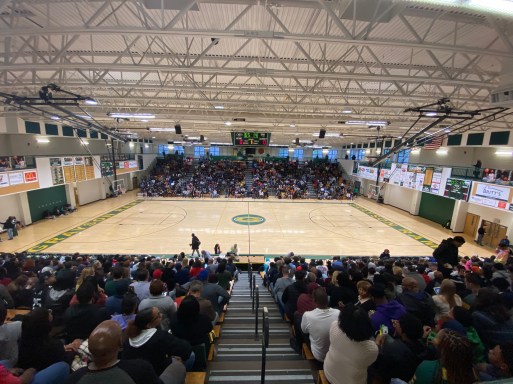
LOGANVILLE, Ga. — Grayson High School senior Caleb Murphy played his first three years of high school basketball at Norcross High School, but in his final season Murphy and the nationally-ranked Rams knocked his former team out of Georgia’s AAAAAAA classification playoffs with a 65-27 win Wednesday night.
“It feels great,” Murphy said after the game. “They brought a big crowd. They feel some type of way that I left, so to play good in front of the whole school, all my old friends and my old coach, it meant a lot. This was personal.”
Murphy, a University of South Florida signee, was held scoreless in the first quarter but quickly turned things around with eight points before the halftime break, all of which came as part of a 15-0 Ram run to go from down four to up 11.
The senior guard admitted that he needed to let the game come to him more than he did in the first quarter, as his father often reminds him from the stands. His coach also told him that he was playing with the ball too much and needed to make one move and go. When he did that and began driving to the rim like his favorite NBA player Russell Westbrook is known for, Grayson took the momentum and ran with it.
For most of the night, Murphy was guarded by Norcross star JT Thor and finished the game with 20 points, two rebounds, a block and a steal. Thor, also a senior, is ranked as the No. 4 player in the state of Georgia for the 2020 signing class per the industry-generated 247Sports Composite. He has narrowed his college choices down to Georgia, Kansas, Kentucky and Oklahoma State.
Thor was one of several future college basketball players to take the court tonight at Grayson as the two teams combined for four of the top 10 players in the 2020 class. Murphy, Grayson’s Mississippi State signee Deivon Smith and Norcross’s Georgia-bound Josh Taylor made up the rest of that group. Taylor is among the players that Murphy said he still keeps up with from his time at Norcross.
To finish out the night, Murphy converted on an up-and-under layup and blew a kiss goodbye to the Norcross student section that booed him for the majority of the night and taunted him with a stuffed animal snake for leaving their school.
“Caleb gets a bad wrap sometimes, but all he wants to do is win,” Grayson head coach Geoffrey Pierce said. “Everything he does in practice and in the game is predicated on trying to get us a W. He’s fun to coach.”
Grayson now moves on to the state semifinals for the third time in four years. Murphy will be making his fourth straight Final Four appearance after making it each of the last three seasons with Norcross. Understanding the stakes, Murphy said that he’ll share a message with the team before their big game.
“One game at a time,” he said. “We can’t look forward to the state championship. We’re close, but we’ve got to take it one game at a time … It’s a bigger stage, brighter lights. I’ll just tell them to stay cool, calm and collected. Let the game come to you and we’ll be straight. We’ve just got to handle business.”
In the semifinals, Grayson will take on defending state champions McEachern, who defeated North Gwinnett in the quarterfinals 75-68 on Tuesday. Tipoff between the Rams and Indians is set for 8:00 p.m. ET on Saturday from Buford City Arena in Buford, Georgia.
U.S. Olympic Team Trials – Maratahon

Veteran runner Dan Vassallo has run more than 74,000 miles during his competitive running career, but the 34-year-old believes that he only has 26.2 miles left.
Vassallo plans to retire after he completes the U.S. Olympic Team Trials – Marathon on Feb. 29 in Atlanta.
“I think that I’ve given the game all that I can give, and that if I were to continue to pursue the game the way that I have over the past 15, 20 years, it’s a fast track to falling out of love with it,” Vassallo said. “I just want to downshift.” Continue reading
Writer’s Note: This story was written in February of 2020 for Intro Sports Reporting and Writing. The assignment required us interview a marathon participant in the U.S. Olympic Team Trials, write a feature story on the runner and travel to Atlanta to provide social media coverage of the athlete on race day.
Cedar Shoals takes down Johnson Tuesday night behind Canty’s big effort
By Palmer Thombs
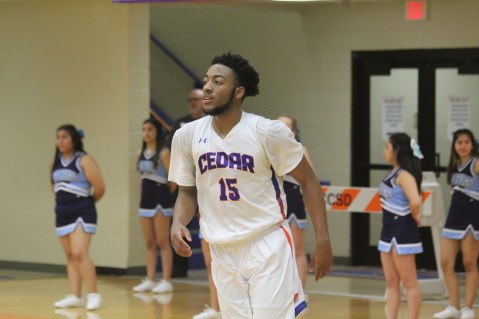
Cedar Shoals defeated Johnson Tuesday night by a score of 69-33 behind Quincy Canty’s 22 points to move to 22-2 on the season. Fellow Cedar senior Tyler Johnson added 19 points of his own while Buddah Johnson led Johnson in scoring with 11 points.
Canty’s dominant performance began on a shaky note as he was called for a technical foul in the first half on a missed dunk for hanging on the rim. Throughout the remainder of the matchup though, Canty redeemed himself with several strong finishes at the rim.
Aside from being the leading scorer Tuesday night, the 6-foot-6 senior also finished as the game’s leader in rebounds with seven as the Jaguars out-rebounded the Knights 23-22 on the night.
Canty will have the opportunity to continue his basketball career after his high school days are over, holding offers from UAB, St. John’s, Kennesaw State and Tennessee State. Johnson also has an offer from Kennesaw State.
Possibly the biggest difference between the two teams Tuesday night was their ability to control possession, a stat that was very apparent on the scoresheet. The Jaguars took advantage of a sloppy performance from the visiting Knights who turned the ball over 29 times to Cedar’s nine. Cedar went into the locker room holding a 31-20 lead but stretched that lead out with a 38-13 second half score, aided greatly by the Johnson turnovers. Jesse Harbin and Buddah Johnson, two starters for the Knights, combined for 13 of their team’s 29 turnovers.
Cedar is 9-0 on the season when playing at home, and it’ll look to improve their home win total to double figures Friday night in the season finale against Walnut Grove. The Jaguars defeated Walnut Grove two weeks ago on the road, 61-59. Friday’s contest will serve as Senior Night for Cedar’s nine seniors.
Writer’s Note: This story was written in January of 2020 for Intro Sports Reporting and Writing. The assignment required us keep statistics at a local high school basketball game and write a game recap.
 Palmer Thombs